
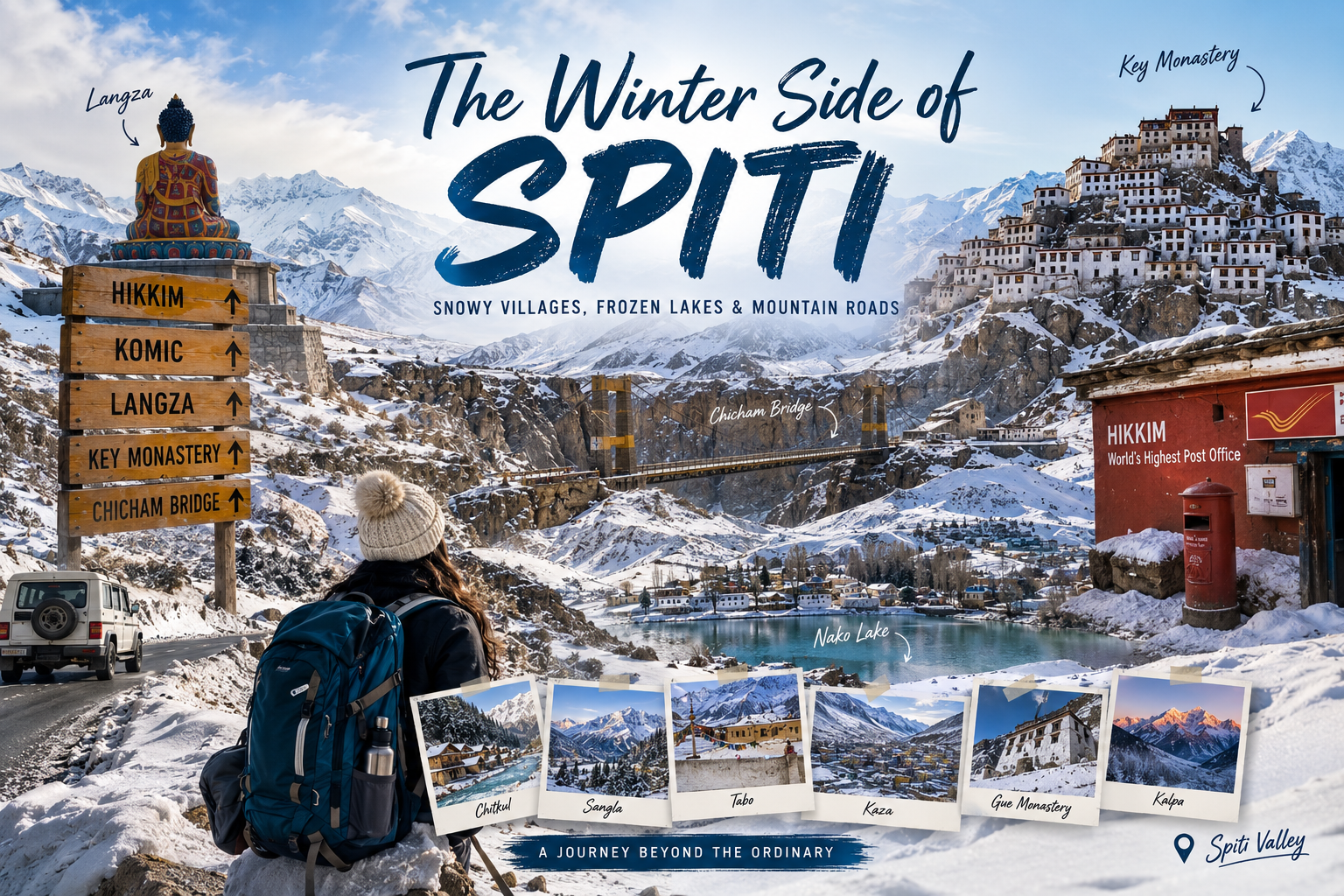
The Winter Side of Spiti: Snowy Villages, Frozen Lakes & Mountain Roads
There is Spiti, and then there is Spiti in winter.
During the warmer months, the valley is known for its rugged mountains, high-altitude villages, monasteries and long mountain roads. But once winter settles in, everything changes. The colours become quieter, the roads get tougher, villages look almost hidden beneath snow and the entire valley seems to slow down.
It is beautiful, but it isn’t an easy holiday.
And that’s exactly what makes a winter Spiti trip so memorable.
You wake up to freezing temperatures, step outside wrapped in layers, and look at mountains that seem to stretch endlessly into the sky. A simple drive can turn into the highlight of the day because the road itself becomes part of the experience.
There are no guarantees in winter. Weather can change quickly, snowfall can affect roads and some high-altitude places may not be accessible. The itinerary may need to change depending on road conditions and safety. The trip plan provided for this journey also clearly notes that access to places such as Hikkim, Komic, Langza and Pin Valley can be blocked because of heavy snowfall.
So, if you’re looking for a comfortable hill-station holiday, winter Spiti may not be the obvious choice.
But if you’re looking for something raw, quiet and completely different, this is where the story gets interesting.
What Makes a Winter Spiti Road Trip Special?
The first thing you’ll notice is the silence.
Spiti has always had a peaceful character, but winter takes that feeling to another level. Snow-covered slopes replace much of the usual colour of the valley, and the small settlements look even more remote.
The journey also brings you closer to the local side of Spiti.
The trip highlights in the itinerary include staying in local homestays, experiencing local hospitality, visiting monasteries, enjoying traditional food and even witnessing traditional dance performances by local children and women.
That makes the experience more than a sightseeing tour.
You’re not simply driving to a viewpoint, taking a photograph and leaving.
You’re spending time in a region where winter affects everyday life in a very real way.
And perhaps that’s the most interesting part of travelling here.
The Journey Begins: Delhi to Shimla
Day 0 – Delhi to Shimla
A winter Spiti itinerary doesn’t really begin in Spiti itself.
It starts in Delhi.
According to the itinerary, the journey begins with a Volvo transfer from Delhi to Shimla, leaving around 9:30 PM and reaching Shimla the following morning.
It is essentially your first night on the road.
There isn’t much sightseeing planned for this part, and that’s a good thing. The real adventure is still ahead.
Use the journey to rest, because once you reach Shimla, the landscape starts changing quickly.
The familiar city roads gradually give way to mountain routes, river valleys and smaller settlements.
By the time you move further towards Kinnaur, you’ll understand that this isn’t going to be an ordinary road trip.
Day 1 – Chitkul and Sangla
From Shimla to the Snowy Landscapes of Kinnaur
Once you reach Shimla, the road trip properly begins.
The route heads towards Chitkul/Sangla, following the Sutlej River towards Karcham before turning towards the Baspa Valley. The itinerary describes Chitkul as the last inhabited village before the Indo-China border and plans arrival at Chitkul or Sangla by evening.
This is one of those days when you should resist the urge to constantly check how much distance is left.
Mountain travel is not really about reaching quickly.
The road itself is the experience.
You’ll see the landscape gradually becoming more dramatic as you move deeper into the mountains. In winter, the cold adds another layer to the scenery, and the journey can feel almost cinematic at times.
Why Chitkul Is Worth Including
Chitkul has a very different personality from the popular hill stations of Himachal Pradesh.
It feels remote.
The village sits high in the mountains, and winter can make the surroundings feel even more isolated. You aren’t coming here for shopping malls or busy tourist streets.
You’re coming for the landscape, the quiet and the feeling of being somewhere far away from everyday city life.
Spend the evening slowly.
Walk around if conditions allow, take in the mountain views and enjoy a warm dinner before settling in for the night.
The itinerary includes an overnight stay in Sangla/Chitkul, making this an important stop rather than just a quick photograph on the way.
Day 2 – Sangla to Tabo/Nako
A Long Mountain Day With Nako Lake Along the Way
The next morning begins early.
After breakfast, the route continues towards Tabo, passing through the Khab area where the Sutlej and Spiti Rivers meet. The itinerary also includes a stop at Nako Lake, described as a peaceful high-altitude lake surrounded by mountains.
This is one of the days when the destination is only half the story.
The landscape keeps changing as you travel deeper into the Trans-Himalayan region. The roads become a bigger part of the adventure, and you’ll start noticing how different Spiti feels from the green valleys you may have passed earlier.
Nako: A Quiet Pause on the Route
Nako is the kind of place that doesn’t need a long list of activities.
The lake, mountain backdrop and peaceful surroundings are enough.
In winter, the atmosphere becomes especially stark and quiet. If conditions are favourable, you’ll get a chance to see the landscape in its coldest and most dramatic form.
But remember that mountain weather doesn’t follow a fixed schedule.
A winter road trip requires flexibility, and the itinerary itself notes that weather and road conditions can lead to changes for safety and comfort.
By evening, you’ll reach Tabo, check in and have dinner.
And after a long day on the road, a warm meal and a comfortable room will probably feel better than any luxury resort.
Tabo: Where the Journey Starts Feeling Like Spiti
Tabo is more than an overnight stop.
The landscape around the village gives you the first strong sense that you’ve entered the Spiti Valley region.
This is where the journey starts feeling less like a conventional Himachal road trip and more like an expedition into a high-altitude desert landscape.
The pace naturally slows down.
The mountains feel bigger.
The settlements feel smaller.
And the cold becomes impossible to ignore.
This is also why packing correctly matters so much for a Spiti Valley winter trip. You need proper layers and winter clothing rather than relying on the kind of jacket you’d normally carry for a regular hill station.
Day 3 – Tabo to Kaza
Ancient Monasteries, Rugged Landscapes and the Road to Kaza
After breakfast, the journey continues towards Kaza, the administrative hub of Spiti Valley.
But you don’t simply drive straight there.
The itinerary includes a visit to Dhankar Monastery, one of the oldest monasteries in the valley, along with stops at Lingthi Waterfall and an ice café before reaching Kaza.
This is one of the most interesting days of the trip because the landscape and culture come together.
Dhankar Monastery
Dhankar is the kind of place where you naturally stop talking for a moment.
The monastery sits dramatically amid the mountains, and its location is as memorable as the structure itself.
In winter, the surrounding landscape can look incredibly stark. Snow, bare mountain slopes and the monastery create a scene that feels far removed from the busy tourist centres of Himachal.
Don’t rush the visit.
Look around.
Take in the views.
And remember that these monasteries are not simply tourist attractions. They are part of the living cultural landscape of Spiti.
Reaching Kaza
By the time you arrive in Kaza, you’ll probably understand why travellers describe Spiti as an experience rather than simply a destination.
Kaza is the main hub for exploring this part of the valley.
The itinerary gives you time for an evening stroll through the local market and cafés after reaching the town.
And honestly, this is a good evening to keep simple.
Have something warm.
Walk around if the weather allows.
Sit in a café.
Talk to the people you’re travelling with.
After spending so many hours on mountain roads, you don’t need another packed sightseeing schedule.
Sometimes the best part of a trip is simply being somewhere you’ve never been before.
Why Kaza Deserves More Than a Quick Stop
Kaza is often treated as the base from which travellers visit other parts of Spiti.
But it also gives you a chance to experience the everyday rhythm of the valley.
You’ll find local shops, cafés and accommodation here, and the town becomes a useful base for the following sightseeing days.
The trip itinerary includes three nights in Kaza, which gives travellers enough time to explore the surrounding places without constantly packing and unpacking.
That makes sense, especially during winter.
You don’t want every day to feel like a race against the clock.
Winter Spiti Is About the Journey, Not Just the Checklist
One thing becomes clear as you move through this itinerary: you shouldn’t approach Spiti with the mindset of collecting destinations.
Yes, there are plenty of places to see.
There are monasteries, villages, bridges, lakes and dramatic viewpoints.
But winter changes the way you experience them.
A road may take longer than expected.
A village may become inaccessible because of snowfall.
A sightseeing stop may need to be shortened.
And sometimes, the best decision is simply to turn back because the conditions aren’t right.
That’s not a failed trip.
That’s mountain travel.
The itinerary specifically allows for alternatives when high-altitude locations become inaccessible during winter and notes that schedules may change according to weather, road conditions and traveller safety.
And honestly, that’s something worth accepting before you book a winter Spiti trip.
You are visiting the Himalayas in their harshest season.
Respecting the mountains is part of the experience.
Day 4 – Exploring the Heart of Spiti Valley
By Day 4, you are properly settled into Kaza. The long road journeys of the previous days are behind you for a while, and now the focus shifts to some of the most recognisable places in Spiti Valley.
This is also the day when the winter landscape really starts to show its character.
Snow-covered roads, barren mountain slopes, tiny villages tucked into the valley and monasteries sitting quietly above the landscape — this is the side of Spiti most travellers come looking for.
The itinerary keeps the day focused on the famous high-altitude places around Kaza, including Key Monastery, Chicham Bridge, Hikkim, Komic and Langza.
But there is one thing to remember before setting out.
Winter access can change
Hikkim, Komic, Langza and other high-altitude areas can become inaccessible during periods of heavy snowfall. The trip notes specifically mention that access to these locations is weather-dependent, so the final sightseeing plan may need to change according to road and weather conditions.
That uncertainty is simply part of travelling to Spiti in winter.
Key Monastery: The Place You Will Remember
If there is one place that almost every first-time visitor associates with Spiti, it is Key Monastery.
Perched high above the valley, the monastery is surrounded by rugged mountains and feels almost inseparable from the landscape around it.
In winter, the setting becomes even more striking.
The white slopes contrast with the earthy colours of the mountains, while the monastery appears to sit quietly above everything below.
But don’t treat Key Monastery as just a photo stop.
Take a little time to look around and appreciate the peaceful atmosphere. The monastery is an important part of Spiti’s Buddhist culture, and visiting it gives you a better understanding of the valley beyond its roads and scenery.
The itinerary describes Key Monastery as one of the major highlights of the sightseeing day and includes it along with the surrounding high-altitude villages.
Chicham Bridge: One of the Most Dramatic Stops
From Key Monastery, the journey continues towards Chicham Bridge.
The bridge has become one of the most recognisable attractions in Spiti, mainly because of its dramatic location above a deep gorge.
Standing there in winter can feel slightly surreal.
The roads, mountains and open sky create a huge landscape around you, while the bridge itself looks surprisingly small against the surrounding terrain.
It is an obvious photography stop, but try not to spend the entire visit looking at your phone.
Walk around carefully, take in the views and appreciate the scale of the mountains.
The itinerary places Chicham Bridge among the main sightseeing highlights around Kaza.
And during winter, the journey to reach it can be just as memorable as the bridge itself.
Hikkim, Komic and Langza: Villages Above the Clouds
After the monastery and bridge, the route moves towards some of Spiti’s most famous villages.
Hikkim, Komic and Langza each have their own character, but what connects them is their high-altitude setting.
These are not typical tourist towns.
There are no busy shopping streets or endless cafés.
Instead, you’ll find small settlements surrounded by huge mountain landscapes.
The itinerary includes Hikkim for its famous high-altitude post office, Komic for its exceptionally high motorable-road setting and Langza for its large Buddha statue.
Together, they make one of the most memorable sightseeing circuits around Kaza.
Hikkim: A Tiny Village With a Famous Post Office
Hikkim is known for its post office and its high-altitude location.
For many travellers, sending a postcard from here becomes a small but memorable part of the journey.
It is the kind of experience that feels wonderfully old-fashioned in a world where almost everything happens instantly on a phone.
Take a photograph, send something to someone back home if the facility is operating, and spend a few minutes simply looking around.
Just remember that winter access isn’t guaranteed.
Heavy snowfall can affect the roads, so don’t make reaching Hikkim the single measure of whether your trip was successful.
Komic: Quiet, Remote and Completely Different
Komic is another village that makes you realise how dramatically people have adapted to life in the high Himalayas.
The landscape around the village is vast and open, with very little of the visual clutter you associate with cities.
In winter, that openness becomes even more noticeable.
Snow can cover sections of the landscape, while the mountains stretch far beyond the village.
If the road is accessible during your visit, Komic can easily become one of the most memorable stops of your Spiti winter itinerary.
But again, weather comes first.
If snowfall makes the route unsafe or inaccessible, the responsible choice is to follow the alternative plan arranged by your travel team.
Langza and the Giant Buddha
Then comes Langza.
The village is famous for its large Buddha statue overlooking the valley, and the surrounding landscape makes it a favourite photography location.
But there is more to the experience than the photograph.
Look around the village.
Notice the traditional houses and the way the settlement fits into the mountains.
Winter gives the entire area a quieter atmosphere, and if you’re lucky with the weather, the combination of snow and mountain light can make the landscape look almost unreal.
This is also a good place to slow down rather than immediately jumping back into the vehicle.
Winter Spiti Is More Than Snow
It would be easy to make this entire blog about snow.
And yes, snow is a huge part of the winter experience.
But what makes Spiti Valley in winter special is the combination of snow and everyday life.
People still live here.
Homes still need heating.
Food still has to be prepared.
Roads still need to be managed.
And travellers get a small glimpse of what life looks like in a high-altitude valley during one of the harshest seasons of the year.
The trip information highlights local homestays, local cuisine and the opportunity to experience Spiti more like a local rather than simply passing through as a tourist.
That is an experience worth paying attention to.
Stay in a Homestay and Experience Local Hospitality
One of the nicest parts of a winter Spiti trip can happen after the sightseeing is over.
You return to your accommodation.
Your hands are cold.
The temperature outside has dropped.
And then someone serves you something warm.
That simple moment can become one of your favourite memories.
The itinerary specifically highlights the homestay experience and local hospitality as part of the trip.
Don’t expect the kind of facilities you would find in a luxury hotel in a major city.
The trip notes also warn that some offbeat properties may not have 24-hour electricity, constant hot water or Wi-Fi.
And honestly, that’s something you should know before travelling.
Winter Spiti isn’t about luxury.
It’s about the experience.
What to Eat During a Winter Spiti Trip
Cold weather has a funny way of making simple food taste better.
After hours on the road, a hot meal can feel like a reward.
Local food is an important part of experiencing Spiti, and the trip highlights mention local cuisines and food experiences during the journey.
Depending on what’s available at your accommodation or local cafés, you may come across warm, filling Himalayan-style meals that are particularly comforting during winter.
Don’t hesitate to ask your hosts what they recommend.
Sometimes the best meal of a trip isn’t the one you found through a travel blog.
It’s the one someone local tells you to try.
A Different Kind of Night in Kaza
After returning from the sightseeing circuit, the evening is yours to slow down.
You could explore the local market if conditions allow, sit in a café or simply return to your accommodation and relax.
And this is where winter Spiti differs from a typical holiday destination.
There may not be a long list of nightlife options.
You may not have perfect mobile connectivity.
You may find yourself sitting indoors with a hot drink while snow falls outside.
And surprisingly, that’s part of the charm.
The quiet gives you something most city holidays don’t – time to actually disconnect.
The Snow Leopard Trail: An Experience for the Adventurous
The itinerary also highlights the idea of retracing the Snow Leopard Trail, with winter offering a possibility of spotting the elusive animal.
However, this should never be treated as a guaranteed wildlife sighting.
Wild animals are unpredictable, and responsible travel means maintaining distance and following local guidance rather than chasing an animal for a photograph.
If wildlife is one of the reasons you’re visiting Spiti, approach the experience with patience.
The possibility itself is exciting.
But the mountains and wildlife deserve respect first.
Day 5 – Another Look at Kaza and Chicham
The itinerary includes another sightseeing day around Kaza, with Key Monastery and Chicham Bridge again forming the main highlights.
At first, having similar locations on consecutive days might seem repetitive.
But winter travel doesn’t always work like a standard summer sightseeing trip.
Weather can affect visibility and road access.
A place that looked one way yesterday can look completely different after snowfall.
And sometimes a second visit means you can actually slow down instead of trying to photograph everything in a hurry.
The second day can also give you more breathing room around Kaza.
Rather than rushing from one point to another, take time to appreciate the surroundings.
Why Keeping Extra Time in Kaza Makes Sense
Kaza is the central base for several of the valley’s major attractions.
Having multiple nights here means you aren’t packing your bags every morning.
The itinerary provides three nights in Kaza, which gives the journey a more practical rhythm.
This is especially useful during winter.
Mountain journeys need flexibility.
If a road is delayed or a sightseeing plan changes, having a base for more than one night makes the trip less stressful.
It also gives you time to experience Kaza itself rather than treating it only as a place to sleep.
Travel Slowly, Especially in Winter
There is a temptation during a trip like this to say:
“I’ve come all this way, so I need to see everything.”
But that isn’t always the best approach.
Spiti is a destination where the journey can be unpredictable.
Road conditions, snowfall and the physical ability of travellers can all affect the day’s schedule. The trip notes specifically mention that itinerary changes may be necessary for safety, comfort and general well-being.
So leave room for change.
If you miss one village because the road isn’t safe, you haven’t missed the whole point of Spiti.
You are still surrounded by the Himalayas.
You are still experiencing a landscape that most people never see in winter.
And there will always be another reason to come back.
Day 6 – Kaza to Gue Monastery and Kalpa
After spending a few days around Kaza, it can feel strange to pack your bags again.
By now, the roads, cold mornings and mountain views have started feeling familiar. You may even have found a favourite café or become used to stepping outside wrapped in several layers.
But the journey isn’t over yet.
The next route takes you away from Kaza towards Kalpa, with a few interesting stops along the way. The itinerary includes a short walk around Kaza in the morning before starting the drive towards Kalpa, passing through Sumdo and visiting Gue Monastery and Nako village.
This day feels less like a sightseeing race and more like the beginning of the return journey.
You’re leaving Spiti, but the landscape still has a few surprises waiting.
A Quiet Morning in Kaza
Before leaving Kaza, take a little time to walk around the town.
There is something nice about seeing a place one last time after you’ve spent several days there. You know the streets a little better now. The mountains don’t feel quite as unfamiliar, and the pace of the town has probably started to feel normal.
Have breakfast, take a final look around and then get ready for the road.
The itinerary specifically keeps a small morning walk around Kaza before beginning the drive towards Kalpa.
It’s a simple idea, but it gives the journey a nice pause before another long day on the road.
Gue Monastery: A Stop With a Story
One of the interesting stops on the way to Kalpa is Gue Monastery, located in Gue village.
The monastery is particularly known for its centuries-old mummy, which has made the small village a curious stop for travellers passing through this region. The itinerary specifically includes a visit to Gue village and its monastery before continuing towards Nako.
This isn’t the kind of place where you need to spend hours.
Instead, take your time, understand why the monastery is significant and appreciate how different this part of the journey feels from the busy tourist destinations people usually associate with Himachal Pradesh.
The road trip has gradually taken you through valleys, villages and monasteries, and Gue feels like another small chapter in that journey.
A Stop at Nako Before Kalpa
Nako appears again on this part of the route.
Earlier in the journey, it was one of the places you passed while travelling deeper into Spiti. Now, you’re seeing it from the perspective of a traveller heading back towards Kinnaur.
The itinerary includes some leisure time in Nako before continuing towards Kalpa.
If the weather is clear, take a moment to enjoy the surroundings rather than treating the stop as just another tick on the itinerary.
One of the nice things about a long Himalayan road trip is that familiar places can feel different depending on the light, weather and direction you’re travelling in.
By evening, the plan is to reach Kalpa, have dinner and spend the night there.
Kalpa: A Beautiful Way to End the Mountain Journey
After the raw landscapes of Spiti, Kalpa brings a slightly different mood.
The village is known for its mountain views and peaceful surroundings, and after several days of driving through the high-altitude landscape, it can feel like a gentle transition back towards the more accessible parts of Himachal Pradesh.
This is also why having an overnight stay here makes sense.
You don’t have to arrive in Kalpa and immediately continue driving.
You get an evening to relax, have dinner and enjoy your final night in the mountains.
The trip plan includes one night in Kalpa as part of the six-night accommodation arrangement.
Day 7 – Kalpa to Shimla and Back to Delhi
The final morning begins at a much slower pace.
According to the itinerary, you’ll wake up in Kalpa, have breakfast and spend some time exploring the area before starting the return journey. The plan also includes a visit to a nearby viewpoint and time for photographs before leaving.
And honestly, don’t underestimate this final morning.
After days of long drives, cold weather and packed sightseeing, it feels good to have a relaxed breakfast and simply enjoy the view.
You don’t need to find another major attraction.
You have already spent several days travelling through one of the most remote and dramatic landscapes in the Himalayas.
Sometimes the best ending is a quiet one.
The Road Back Is Part of the Trip Too
Eventually, it’s time to leave Kalpa.
The itinerary takes you towards Shimla before the return transfer to Delhi.
This is the part of the journey when you may start looking back at everything you’ve seen.
The snowy villages.
The monasteries.
The long mountain roads.
The freezing mornings.
The small cafés.
The conversations inside the vehicle.
And all those moments when someone said, “Bas yahan ek photo lete hain,” and somehow that one photo stop became twenty minutes.
That’s road-trip life.
And that’s what makes a winter Spiti road trip different from simply flying somewhere, checking into a hotel and visiting attractions.
The journey itself becomes one of your memories.
What Should You Expect From a Winter Spiti Trip?
Before you decide that this is your next holiday, there are a few things you should understand.
Winter Spiti is beautiful, but it asks you to adjust.
You can’t expect the same facilities you would get at a regular tourist destination. Some remote properties may not have 24-hour electricity, continuous hot water or reliable Wi-Fi. The trip notes specifically mention that travellers should be prepared for limited amenities in some offbeat areas.
Water and electricity can also be limited in hilly regions, and some properties may follow fixed timings for hot and cold water.
So, if your idea of a holiday includes a luxury hotel, unlimited hot showers and perfect internet every evening, winter Spiti may test your patience.
But if you’re comfortable with simple living for a few days, the experience becomes much more rewarding.
What to Pack for Winter Spiti
Packing for Spiti in winter is not the time to follow the “I’ll just carry one warm jacket” strategy.
You need layers.
A practical winter packing list should include:
- A proper insulated winter jacket
- Thermal innerwear
- Warm sweaters or fleece layers
- Woollen socks
- Gloves
- A warm cap
- Comfortable, insulated shoes
- Sunglasses
- Sunscreen
- Lip balm and moisturiser
- Personal medicines
- Power bank
- Reusable water bottle
- Important documents and identification
Keep your essentials somewhere easily accessible because you may need them during long road journeys.
And don’t pack only for photographs.
That stylish jacket might look amazing against a snowy mountain, but if it doesn’t actually keep you warm, you’ll regret bringing it.
Be Ready for Changing Road Conditions
One of the biggest differences between a summer and winter Spiti trip is the unpredictability of the roads.
Snowfall, ice, landslides and changing weather can affect the route. The itinerary notes that weather, road conditions and the physical ability of participants can lead to changes in the schedule, with safety and comfort taking priority.
This is important enough to repeat.
Don’t treat the itinerary as an unchangeable promise.
If a road becomes unsafe, the plan may need to change.
High-altitude locations such as Hikkim, Komic, Langza and Pin Valley can be blocked during winter because of heavy snowfall. In such situations, alternatives may be considered depending on what is feasible.
That flexibility is part of responsible mountain travel.
Why Experienced Drivers Matter in Winter
Winter mountain driving isn’t the same as driving on a normal highway.
Black ice, snow-covered stretches and sudden changes in road conditions can make certain sections challenging.
The trip plan includes experienced drivers, and the vehicle is equipped with snow chains and an oxygen cylinder for emergency situations.
That doesn’t mean travellers should become careless.
It means you should still respect the conditions and listen to the driver or trip leader when they advise against stopping or travelling further.
The mountains aren’t impressed by Instagram content.
Safety wins.
Every time.
Is Winter Spiti Suitable for Everyone?
Not necessarily.
And that’s completely okay.
Winter Spiti can be a wonderful choice for people who enjoy:
- Snow and mountain landscapes
- Long road trips
- Photography
- Quiet destinations
- Adventure travel
- Local culture and monasteries
- Simple homestay experiences
- Experiencing places outside the usual tourist season
It may not be ideal for someone who prefers luxury resorts, predictable weather, short travel times or a packed list of easily accessible attractions.
Knowing this before you go can make a huge difference.
Don’t book winter Spiti because you’ve seen a beautiful snowy photograph.
Book it because you’re genuinely interested in experiencing the journey behind that photograph.
The Real Luxury of Winter Spiti Is the Silence
There’s a strange beauty in being somewhere where your phone isn’t constantly demanding your attention.
The mountains are quiet.
The roads are quieter.
The evenings are slow.
You may find yourself talking more because there isn’t much else competing for your attention.
A cup of tea becomes a proper break.
A conversation becomes longer.
And a simple view outside the window can hold your attention for much longer than you’d expect.
That is one of the things winter Spiti gives you without trying.
Space.
Don’t Expect Everything to Go According to Plan
This might be the most important piece of advice for anyone planning this journey.
Leave your perfectionist itinerary at home.
You may not reach every village.
You may spend longer on the road than expected.
A sightseeing stop might be cancelled.
The weather might completely change your plans.
And that’s okay.
The trip notes themselves make it clear that unforeseen situations, road conditions and natural circumstances can affect the itinerary.
A good winter trip isn’t one where everything happens exactly according to a spreadsheet.
It’s one where you return safely with a collection of experiences you couldn’t have planned perfectly in advance.
And Maybe That’s Why Winter Spiti Stays With You
By the time you leave Kalpa and begin heading towards Shimla, you may realise that the most memorable parts of the trip weren’t necessarily the famous places.
Maybe it was the first time you saw snow-covered mountains from the vehicle window.
Maybe it was sitting inside a warm homestay after spending hours in the cold.
Maybe it was a monastery sitting quietly against a huge mountain.
Maybe it was a conversation with a local.
Or maybe it was simply standing somewhere in Spiti and realising how incredibly small you feel in front of the Himalayas.
That’s the side of Spiti that photographs don’t always capture.
And that’s the side worth travelling for.
Winter Spiti Travel Tips You’ll Be Glad You Knew
A winter Spiti trip needs a little more preparation than a regular mountain holiday. The cold is intense, roads can change quickly and some parts of the valley may not be accessible after heavy snowfall.
The good news is that you don’t need to overcomplicate it. A few practical decisions before leaving can make the journey much more comfortable.
Here are some things worth keeping in mind before you head towards the frozen side of Spiti.
Keep Your Schedule Flexible
Don’t plan every hour of the trip as if you’re travelling through a city.
Mountain weather has its own plans.
Snowfall, road conditions and other unexpected situations can affect the route. The itinerary itself mentions that schedules may change depending on weather, road conditions and the physical ability of travellers, with safety and comfort taking priority.
So, if one sightseeing stop gets cancelled, don’t let it ruin the trip.
There will still be plenty to experience.
Carry Enough Warm Layers
Spiti in winter is genuinely cold, so proper winter clothing is essential.
Instead of carrying one extremely thick jacket and calling it a day, dress in layers. This makes it easier to adjust when you’re inside a vehicle, in your accommodation or outside in the snow.
Your basic winter Spiti kit should include:
- Thermal innerwear
- Fleece or woollen layers
- A good insulated jacket
- Warm socks
- Gloves
- Woollen cap
- Comfortable winter shoes
- Sunglasses
- Sunscreen
- Lip balm and moisturiser
- Personal medicines
- Power bank
And please don’t forget sunscreen.
Snow and high-altitude sunlight can be surprisingly harsh even when the temperature is freezing.
Don’t Expect a Luxury Holiday
This is probably the biggest mindset shift you need before booking a Spiti Valley winter trip.
Some of the places on the route are remote, so accommodation can be simple. The itinerary notes that certain offbeat properties may not have 24-hour electricity, hot water or Wi-Fi.
Water and electricity can also be limited in hilly areas, with some properties following fixed timings for hot and cold water.
So don’t compare a remote Spiti homestay with a five-star hotel in a city.
The experience is different.
You’re choosing mountain landscapes, local hospitality and a much quieter way of travelling.
Eat Local and Keep Yourself Warm
Food becomes a surprisingly important part of a winter journey.
After spending hours on snowy mountain roads, you won’t be thinking about fancy meals. You’ll probably want something hot, filling and comforting.
The itinerary also highlights local cuisine and the opportunity to experience food prepared with local ingredients and traditions.
If you’re staying in a homestay, ask your hosts what they usually prepare.
That’s often a better way to discover local food than simply looking for a familiar restaurant menu.
And keep some snacks with you during long drives. Not every stretch of the route will have a convenient café or shop.
Respect the Monasteries and Local Culture
Spiti isn’t only about dramatic landscapes.
Its monasteries and villages are an important part of the region’s identity.
Places such as Key Monastery aren’t just sightseeing points to photograph and leave. They are part of the cultural and spiritual life of the valley.
The itinerary specifically includes visits to monasteries and encourages travellers to experience the local culture and hospitality.
Dress respectfully, follow local instructions and avoid disturbing people who are simply going about their daily lives.
A little respect goes a long way.
Don’t Chase the Perfect Photograph
Winter Spiti is obviously going to tempt you to take a lot of photographs.
Snowy roads?
Photo.
Mountain view?
Photo.
Monastery?
Definitely photo.
But don’t let the camera become the whole trip.
Sometimes the best thing to do is put your phone away for five minutes and simply look around.
The landscape is one of the main reasons people choose a winter Spiti road trip, but the memories you make between the photographs are what you’ll probably remember longest.
Who Should Plan a Winter Spiti Trip?
Winter Spiti can be an excellent choice if you enjoy travelling somewhere that feels different from the usual holiday destinations.
It is particularly suited to travellers who love:
- Snow-covered mountain landscapes
- Road trips
- Photography
- Adventure
- Remote villages
- Buddhist monasteries
- Local food
- Homestay experiences
- Quiet destinations
- Offbeat Himalayan travel
The itinerary itself describes the experience as being suited to nature, adventure, travel and photography enthusiasts, with a focus on local culture and homestay experiences.
But if you want predictable weather, luxury facilities and easy sightseeing, you may want to choose another season.
And that’s not a bad thing.
Spiti doesn’t need to be everyone’s kind of holiday.
Frequently Asked Questions About Winter Spiti
Is Spiti Valley open in winter?
Winter travel is possible, but access to specific high-altitude areas can change according to snowfall and road conditions. Places such as Hikkim, Komic and Langza may become inaccessible during heavy snowfall, so the sightseeing plan needs to remain flexible.
Is winter Spiti suitable for first-time visitors?
Yes, provided you understand what you’re signing up for. Proper winter clothing, patience and flexibility are important. It is better to travel with an experienced team and follow local advice when road or weather conditions become difficult.
How many days are enough for a winter Spiti trip?
The itinerary used for this trip covers 7 nights and 8 days, with overnight stays in Sangla/Chitkul, Tabo/Nako, Kaza and Kalpa.
This gives enough time to experience the main route without trying to squeeze everything into a very short journey.
Can I visit Hikkim, Komic and Langza in winter?
You can visit them if road and weather conditions allow. However, access isn’t guaranteed. Heavy snowfall can block these high-altitude areas, so alternative sightseeing may be arranged when necessary.
What kind of accommodation can I expect in Spiti?
Expect a mix of hotels and homestays, particularly in remote areas. Some properties may have limited electricity, hot water or Wi-Fi, so travellers should be prepared for simpler facilities.
Is mobile connectivity and Wi-Fi reliable everywhere?
You shouldn’t depend on constant connectivity during a winter Spiti trip. Remote properties may have limited Wi-Fi, and the itinerary notes that some offbeat accommodations may not offer Wi-Fi or uninterrupted electricity.
Can the Spiti itinerary change?
Yes. Weather, snowfall, road conditions and other unforeseen circumstances can affect the planned schedule. The itinerary specifically states that changes may be made in the interest of safety and traveller comfort.
What makes winter Spiti different from a summer Spiti trip?
Winter completely changes the atmosphere of the valley. Snow covers parts of the landscape, some villages become difficult to access and the pace of travel becomes slower. You also experience a quieter side of Spiti, with local homestays, winter food and fewer typical tourist comforts.
The Winter Side of Spiti Is Worth the Journey
Spiti in winter isn’t polished.
The roads can be challenging. The temperatures can be uncomfortable. Some places may be inaccessible, and the facilities in remote areas can be basic.
But somewhere between those challenges is the reason people fall in love with this place.
It’s the feeling of driving through a valley covered in snow.
It’s seeing a monastery sitting quietly against enormous mountains.
It’s walking through a small Himalayan village where everything feels miles away from the rush of city life.
It’s coming back from the cold and sitting down to a warm local meal.
It’s meeting people who call this harsh landscape home.
And it’s realising that travel doesn’t always have to be comfortable to be meaningful.
The winter itinerary itself focuses on exactly these experiences – snowy landscapes, local hospitality, monasteries, traditional food, village life and the possibility of following the Snow Leopard Trail.
Final Thoughts
The Winter Side of Spiti isn’t really about escaping the cold.
It’s about experiencing what happens when the Himalayas slow everything down.
For a few days, you trade crowded streets for empty mountain roads, constant notifications for quiet evenings and familiar comforts for a closer look at local life.
The journey from Delhi to Shimla, Sangla and Chitkul, Tabo, Kaza, the high-altitude villages, Gue and finally Kalpa makes the road trip as important as the destinations themselves.
And that’s probably the best way to approach Spiti in winter.
Don’t go expecting everything to be perfect.
Go expecting something different.
Go for the snow-covered villages, the monasteries, the mountain roads, the local food and the stories you’ll bring back with you.
Most importantly, go with enough patience to let the mountains set the pace.
Because when Spiti turns white, it doesn’t just look different.
It feels different.
And that’s what makes a winter journey here so unforgettable.
Ready to Experience Winter Spiti?
If snowy mountain roads, remote Himalayan villages and a proper winter road trip sound like your kind of adventure, Spiti Valley in winter deserves a place on your travel list.
The route, however, needs to be planned carefully because weather and road conditions can affect access to several high-altitude locations.
So pack your warmest layers, keep your plans flexible and get ready for a side of Spiti that looks nothing like the usual summer photographs.
Sometimes, the best journeys are the ones where the mountains decide the pace.
Planning your winter Spiti adventure and need help with the itinerary? Get in touch with TrippingCube and let’s start planning your journey to the mountains.

