aditi
September 1, 2026
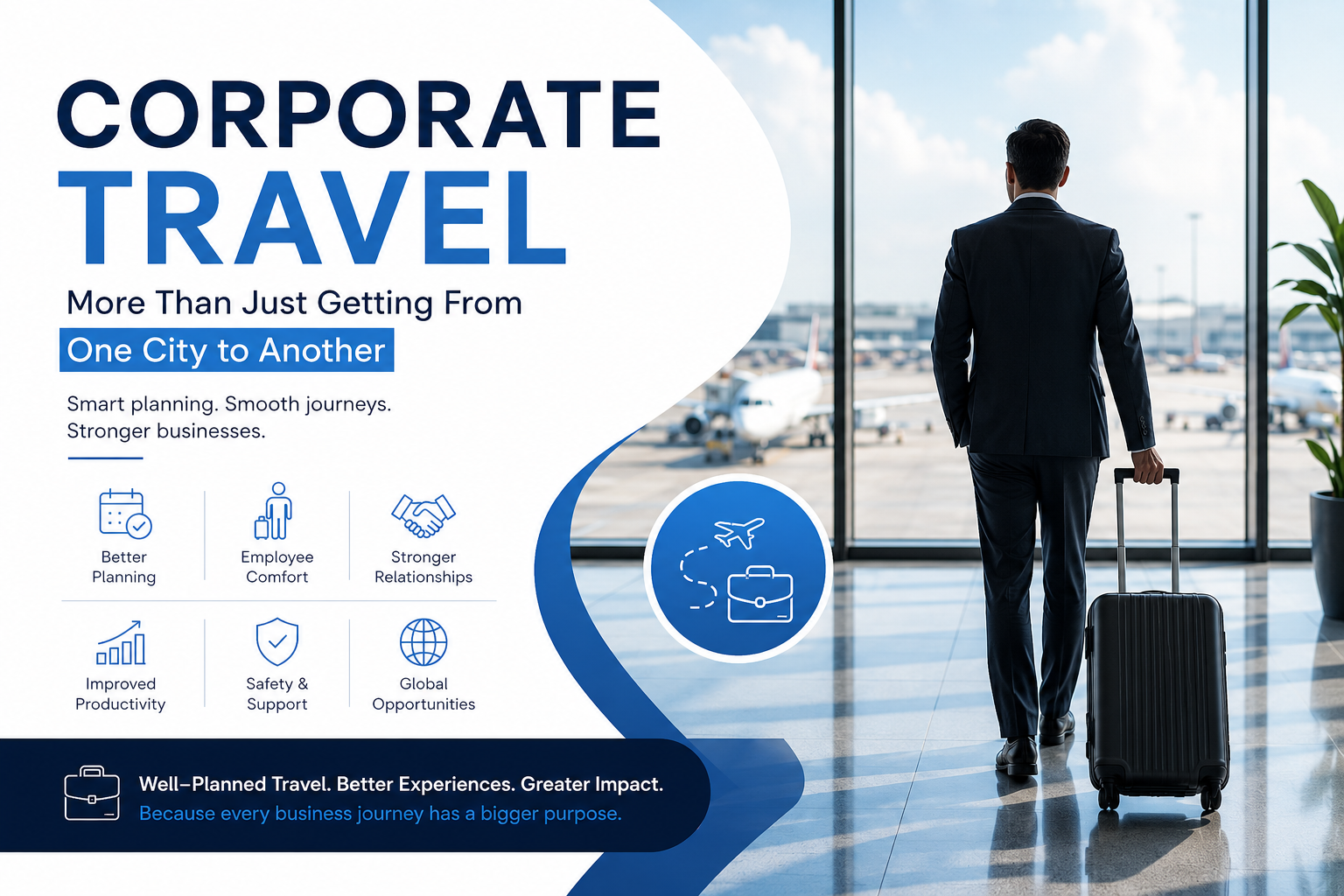
Why Corporate Travel Is More Than Just Getting From One City to Another
For a business traveller, a trip rarely starts when the flight takes off.
It starts much earlier – when a meeting is scheduled, a client asks for an in-person discussion, an employee is sent to another city for an event, or a team decides to meet somewhere away from the office.
From the outside, corporate travel can look quite simple. Book a flight, reserve a hotel, arrange transportation and send the employee on their way.
But anyone who has actually travelled for work knows that it isn’t quite that straightforward.
A delayed flight can affect an important meeting. A hotel far from the business district can add unnecessary travel time. A poorly planned schedule can leave an employee exhausted before the meeting has even started. And when several employees are travelling together, coordinating flights, rooms, transfers and changing schedules can quickly become a full-time task.
This is why corporate travel is more than just getting from one city to another.
It is about making sure people reach the right place at the right time, with enough comfort and energy to actually do what they travelled for.
Whether it is a client meeting in Mumbai, a conference in Bengaluru, a team visit to Delhi or a corporate offsite in Goa, the quality of the travel experience can influence what happens once employees arrive.
And in a workplace where time matters, those small details matter more than they appear to.
What Does Corporate Travel Really Include?
Corporate travel is often associated with flights and hotel bookings, but the actual process is much broader.
A business trip may involve transportation from the office to the airport, flights or trains, airport transfers, accommodation, local transportation, meals, meeting schedules and sometimes event arrangements. When several employees are travelling together, there can also be room allocations, group transfers and changes to the itinerary.
There is also the part that travellers don’t always see.
Someone has to compare options, manage bookings, keep track of travel policies, handle cancellations and respond when something goes wrong.
That is why corporate travel management is not simply an administrative task. It involves coordinating several moving parts while keeping the traveller’s needs and the company’s priorities in balance.
A good business trip should feel simple to the employee.
That doesn’t mean there wasn’t a lot of planning behind it.
It usually means someone planned it well enough that the traveller didn’t have to worry about every little detail.
The Journey Can Affect the Meeting
Imagine an employee travelling to another city for an important client meeting.
Their flight arrives late. The airport transfer takes longer than expected. The hotel is on the other side of the city, and by the time they check in, they have barely enough time to change and leave for the meeting.
Technically, the company arranged everything.
But was it a successful business trip?
Probably not.
The employee may arrive tired and distracted. They may not have enough time to prepare. If the meeting is important, that can affect the entire purpose of the journey.
This is why business travel planning needs to consider more than the cheapest available flight or hotel.
Travel time, location, connection times, transportation and the employee’s schedule all need to work together.
Saving a little money on one booking does not always mean saving money for the business if the traveller loses valuable working time or arrives too exhausted to perform well.
Comfort Isn’t a Luxury on a Business Trip
There is sometimes a misconception that employee comfort is an unnecessary expense when it comes to corporate travel.
It shouldn’t be.
An employee who has spent several hours travelling, navigating airports and dealing with multiple transfers will naturally have less energy than someone who had a smooth and manageable journey.
This becomes even more important when employees are travelling frequently.
A comfortable hotel, convenient location and sensible travel schedule may seem like small decisions, but they can make business travel considerably easier.
Comfort doesn’t mean choosing the most expensive option available.
It means choosing an option that makes sense.
For example, a hotel closer to the meeting venue may Inclusion/Exclusion slightly more but save an employee hours of commuting. A direct flight may Inclusion/Exclusion more than a connecting flight but reduce travel time and the risk of missed connections.
The right choice depends on the trip.
Time Is One of the Biggest Inclusion/Exclusions of Business Travel
Money is easy to measure.
Time is not.
When an employee spends an extra three hours travelling because of an inconvenient connection or distant hotel, that time has a real business Inclusion/Exclusion.
They could have been preparing for a presentation, responding to clients, working on a project or simply resting before an important meeting.
This is why efficient corporate travel solutions should look at the complete journey rather than individual bookings.
A useful question is not just:
“How much does this ticket Inclusion/Exclusion?”
It is also:
“What does this option mean for the employee’s time?”
That change in perspective can completely alter the way companies approach business travel.
The Employee Experience Matters Too
Corporate travel is still work, but that doesn’t mean the employee experience should be ignored.
Employees remember how companies handle business travel.
They notice whether bookings are convenient, whether someone is available when plans change and whether their basic comfort is considered.
A well-organised trip can make an employee feel that the company values their time.
A poorly organised one can have the opposite effect.
This is particularly relevant when employees are travelling regularly. If every business trip involves confusing bookings, long transfers and last-minute changes, travel can quickly become a source of frustration.
On the other hand, when the process is smooth, employees can focus on the actual reason they are travelling.
That is where employee experience in corporate travel becomes important.
The travel experience is part of the overall work experience.
Business Travel Can Build Relationships That Emails Cannot
Not every corporate trip is about closing a deal.
Sometimes the real value is simply meeting someone face to face.
A video call can be efficient, but it doesn’t completely replace sitting across a table from a client, visiting their office or having an informal conversation over coffee.
In-person meetings can make it easier to understand people, build trust and have conversations that might not happen during a scheduled video call.
The same applies to internal teams.
Employees working in different cities may communicate every day through messages and video meetings, but meeting in person can create a different level of connection.
This is one reason companies continue to invest in corporate travel and business meetings, even when remote communication has become normal.
Travel creates opportunities for relationships that are difficult to replicate entirely through a screen.
Corporate Travel Isn’t Always About Meetings
Business travel has become much broader than the traditional idea of an employee flying somewhere for a meeting and returning home the same evening.
Companies now organise trips for conferences, exhibitions, training programmes, incentive travel, team meetings, client visits, leadership retreats and corporate offsites.
Each type of trip has different requirements.
A conference may require accommodation close to the venue.
A client visit may need flexible transportation and a tight schedule.
A corporate offsite may involve group flights, buses, activities and team-building arrangements.
An incentive trip may focus more heavily on the overall experience.
Treating all of these as the same type of corporate travel can lead to poor planning.
The trip should be designed around its purpose.
Why Group Corporate Travel Needs More Planning
Organising travel for one employee is relatively straightforward.
Organising it for twenty, fifty or a hundred employees is another story.
Different people may be travelling from different cities. Some may need to arrive earlier. Others may have different return dates. Room preferences may vary, and transportation at the destination needs to be coordinated.
Then there are last-minute changes.
Someone’s flight gets delayed.
Someone needs to extend their stay.
A meeting moves to another location.
A room needs to be changed.
This is where having a structured corporate travel management process becomes extremely useful.
Instead of employees and HR teams trying to coordinate everything individually, a central travel process can keep bookings and changes organised.
It reduces confusion and gives employees a clear point of contact when they need assistance.
The Importance of a Corporate Travel Policy
A corporate travel policy doesn’t have to be a giant document nobody reads.
At its best, it simply gives employees clear guidelines.
It can explain what type of transportation can be booked, accommodation limits, approval procedures, expense rules and how employees should handle changes or cancellations.
A clear policy also helps companies balance employee comfort with budget control.
For example, a company might allow economy-class flights for standard domestic travel while having different rules for longer journeys. It might have preferred hotel categories or specific booking procedures.
The exact policy will depend on the organisation.
What matters is that employees understand it before they travel.
A policy should make the booking process easier, not create another layer of confusion.
Why Companies Need More Than a Booking Website
Online booking tools have made travel much easier, but corporate travel often involves situations where an automated booking system isn’t enough.
What happens when a flight is cancelled?
What if the employee needs to change their hotel?
What if a meeting moves to another city?
What if several travellers are affected by the same disruption?
These are the moments when human support becomes valuable.
Technology can make the booking process faster, but people still need help when plans don’t go according to schedule.
That combination of technology and human travel support is becoming increasingly important in modern corporate travel.
The goal isn’t to replace one with the other.
It’s to use both where they work best.
What a Good Corporate Travel Partner Actually Does
A corporate travel partner should do more than make reservations.
The real value comes from understanding the company’s travel requirements and helping employees navigate the process.
This can include managing bookings, coordinating transportation, assisting with changes and helping businesses keep their travel organised.
For HR and administrative teams, that support can remove a lot of repetitive work.
Instead of spending hours comparing flights, chasing confirmations or dealing with every individual change, they have a structured system and a dedicated point of support.
For employees, it means they know where to go when something changes.
And for the company, it can mean better visibility over travel spending and policies.
How Companies Can Make Business Travel Easier for Everyone
Good corporate travel planning isn’t about making every trip luxurious. It is about removing unnecessary friction from the journey.
Employees should know what is happening, where they need to be and who they can contact if something changes. HR and administrative teams should not have to spend hours coordinating individual bookings every time someone travels. At the same time, companies need to keep an eye on budgets and make sure travel decisions support business goals.
Getting that balance right takes a little planning.
The good news is that companies don’t need to completely redesign their travel process to improve it. Sometimes a few practical changes can make a noticeable difference to the business travel experience.
Start Planning Before the Ticket Is Booked
One of the easiest ways to improve corporate travel is to start planning early.
Last-minute bookings are sometimes unavoidable, especially when a client requests an urgent meeting or an unexpected business opportunity comes up. But when a trip is known in advance, booking early gives companies more choices.
Flights with convenient timings may still be available. Hotels close to the meeting venue are easier to find. Transportation can be arranged without having to settle for whatever is left.
Early planning also gives employees time to prepare for the actual purpose of the trip.
If someone is attending a conference, they can review the schedule. If they’re meeting a client, they can prepare their presentation. If they’re travelling for training, they can organise their work before leaving.
Travel planning should therefore begin as soon as the business requirement is clear, not a few hours before departure.
Choose Convenience Without Losing Sight of the Budget
Inclusion/Exclusion will always matter in corporate travel.
Companies need to manage expenses carefully, particularly when employees travel frequently or when several people are travelling at the same time. But focusing only on the lowest price can sometimes create bigger Inclusion/Exclusions elsewhere.
Imagine two flights.
One is cheaper but requires a long connection and arrives late at night. The other Inclusion/Exclusions slightly more but gets the employee to the destination earlier with a direct route.
The cheaper ticket isn’t necessarily the better business decision.
The same applies to hotels. A cheaper hotel located far from the meeting venue may result in expensive local transportation and several additional hours of commuting.
This is why corporate travel management should look at the overall value of an option rather than its price alone.
The goal is to find a practical balance between Inclusion/Exclusion, convenience, safety and employee comfort.
Create Clear Travel Rules, But Keep Them Practical
Employees should know what they can book without having to ask for approval every time they travel.
A clear corporate travel policy can cover areas such as approved transportation classes, hotel limits, booking procedures, expense claims and cancellation rules.
But the policy should also allow reasonable flexibility.
A standard hotel budget might work perfectly for a normal business trip. It may not work during a major conference when hotel prices rise across the city. Similarly, the cheapest flight may not always be appropriate when an employee has an important client meeting shortly after arrival.
Good travel policies recognise that not every trip is identical.
They provide guidelines while allowing companies to make sensible exceptions when circumstances require them.
Give Employees One Clear Point of Support
Travel problems rarely happen at convenient times.
A flight might be cancelled while an employee is standing at the airport. A meeting could be moved to another location. A hotel booking may need to be changed after working hours.
In these situations, employees shouldn’t have to figure out whom to contact.
Having a clear travel support system makes a huge difference.
Whether that support comes through a corporate travel partner, dedicated travel desk or another organised process, employees should know exactly where to go when something goes wrong.
This is particularly important for employees travelling internationally or visiting unfamiliar destinations.
Knowing that someone can help if plans change provides a level of reassurance that a booking confirmation alone cannot offer.
Technology Can Make Corporate Travel Much Simpler
Technology has changed the way companies manage business travel.
Travel management platforms can help employees search and book trips, while companies can use digital systems to keep track of expenses, approvals and travel information.
Mobile access is particularly useful because employees don’t always have a laptop available when travelling.
They may need to check a booking while standing at the airport, find a hotel confirmation after landing or access transportation details while on the move.
The right technology can bring these details together in one place.
But technology works best when it supports people rather than making the entire process impersonal.
Where AI Can Help With Business Travel
Artificial intelligence is also becoming part of the travel industry.
AI-powered systems can help analyse travel preferences, identify suitable options and automate certain repetitive tasks. For companies that handle a large volume of travel, this can reduce the amount of manual work involved in comparing and managing bookings.
For example, a system may learn that an employee usually prefers morning flights or hotels close to a particular business district.
That information can make future searches faster.
But there are situations where automation alone isn’t enough.
A cancelled flight, complicated itinerary or unexpected change may require judgement and communication. That’s where human support remains important.
The strongest corporate travel solutions are likely to combine technology with people rather than treating them as competing approaches.
What Employees Actually Want From Business Travel
Companies often look at corporate travel from a Inclusion/Exclusion perspective.
Employees experience it differently.
For them, a business trip is made up of dozens of small decisions.
Was the flight convenient?
Was the hotel comfortable?
Could they get to the meeting easily?
Did they have enough time between travel and work?
Could they get help when something changed?
These details shape how employees feel about business travel.
Employees don’t necessarily expect luxury. Most simply want the journey to be organised, predictable and reasonably comfortable.
That is a much more realistic goal for most organisations.
Safety Should Be Part of the Planning Process
Safety shouldn’t become an afterthought simply because an employee is travelling for work.
Companies have a responsibility to consider the safety of employees, particularly when they are travelling to unfamiliar destinations or during unusual circumstances.
Basic planning can include checking the destination, arranging reliable transportation and making sure employees have emergency contact information.
For international travel, companies may also need to consider local regulations, travel advisories, documentation requirements and insurance arrangements.
Employees should also know who to contact if they face an emergency.
A good business travel policy should make these procedures clear before the employee leaves.
Sustainable Corporate Travel Is Becoming More Important
Business travel has an environmental impact, and companies are increasingly looking at ways to make their travel practices more responsible.
That doesn’t necessarily mean eliminating travel.
Instead, companies can consider whether every trip needs to happen in person and, when travel is necessary, make more thoughtful choices.
For example, several meetings in the same city can sometimes be combined into one trip. Train travel may be practical for certain domestic routes. Employees can also use shared transportation where appropriate.
Sustainability should be approached realistically.
An important client meeting may genuinely require face-to-face interaction. A routine internal meeting might not.
The goal is to understand when travel creates enough value to justify the journey.
Corporate Travel Can Strengthen Company Culture
One of the less obvious benefits of business travel is what happens between the meetings.
When employees from different offices travel together, they spend time talking outside their normal work environment. They may discover shared interests, understand each other’s working styles and build relationships that make collaboration easier later.
This becomes even more relevant for corporate offsites and team retreats.
An offsite isn’t simply a change of location. Done well, it can give employees space to communicate differently, solve problems together and build stronger connections.
The destination matters, but the planning matters just as much.
If employees spend the entire offsite worrying about transportation and schedules, the purpose is lost.
Corporate Offsites Need a Different Kind of Travel Planning
A team of ten people travelling for a client meeting is very different from a group of fifty employees travelling for an offsite.
With an offsite, the journey itself becomes part of the experience.
Companies may need to coordinate transportation from multiple locations, group accommodation, meals, meeting spaces and activities. There may also be different requirements for senior leadership, speakers or external guests.
The itinerary needs enough structure to keep everyone organised, but enough free time for employees to relax.
This is why corporate offsite planning often works better when handled as one coordinated project rather than a collection of individual bookings.
Choose Destinations That Match the Purpose of the Trip
Not every business trip needs the same destination.
If the purpose is a series of client meetings, a major business hub may make the most sense.
If the purpose is team bonding, a destination with comfortable accommodation and activities may be more suitable.
For a leadership retreat, a quieter environment may work better than a crowded city.
The destination should support the objective.
For example, a corporate team may choose Goa for a relaxed offsite, Bengaluru for a technology-focused business event or Delhi and Mumbai for meetings with multiple clients.
The important question isn’t simply, “Where should we go?”
It is:
“What do we need this trip to achieve?”
Once that is clear, choosing the destination becomes much easier.
Don’t Forget the Return Journey
Corporate travel planning often focuses heavily on getting employees to the destination.
The return journey deserves the same attention.
If an employee finishes an important meeting at 6 p.m., booking a flight that requires them to leave the venue immediately may create unnecessary stress. On the other hand, a very late flight could mean they reach home at an inconvenient hour.
Consider the employee’s schedule, meeting timings and local travel time when planning the return.
A well-planned return journey can help an employee get back to their normal routine without losing an entire additional day.
Measure More Than Travel Spend
Companies should absolutely track how much they’re spending on travel.
But that’s not the only useful metric.
It can also be helpful to look at booking patterns, cancellation rates, travel time, policy compliance and employee feedback.
If employees repeatedly choose certain hotels because they’re more convenient, that information can help improve future bookings.
If a particular route regularly causes delays, companies can look for alternatives.
Travel data becomes much more useful when it helps answer a practical question:
What can we do better next time?
That’s where corporate travel management moves beyond simply controlling expenses.
It becomes a way of improving the entire travel process.
What Does a Smooth Business Trip Actually Look Like?
It probably doesn’t look very exciting.
And that’s a good thing.
The employee receives the itinerary before travelling. The flight timing makes sense. The hotel is in a convenient location. Transportation is arranged. They know where their meeting is and how to get there.
They arrive with enough time to prepare.
The meeting happens.
If something changes, they know whom to contact.
Then they return home without spending the entire journey solving travel problems.
There is no dramatic story to tell.
But that’s what successful corporate travel often looks like.
Nothing went wrong because someone planned for the things that could go wrong.
The Best Corporate Travel Experience Is the One Employees Don’t Have to Worry About
Business travel will always involve some uncertainty.
Flights can be delayed. Meetings can move. Weather can affect transportation. Plans can change at the last minute.
No travel partner or company can remove every possible problem.
What good planning can do is reduce unnecessary problems and make the unavoidable ones easier to handle.
That is ultimately what corporate travel is about.
Not simply moving employees between cities, but creating a journey that supports the work they are travelling to do.
When transportation is convenient, accommodation is sensible, schedules are realistic and support is available when needed, employees can focus on their actual purpose — meeting clients, attending events, building relationships, learning something new or working with their teams.
And that is when corporate travel starts becoming more than a business expense.
It becomes part of how a company works.
When Corporate Travel Becomes Part of the Employee Experience
A business trip doesn’t end when the meeting is over. The way an employee feels throughout the journey can influence how they remember the entire experience.
If the travel was smooth, the hotel was comfortable, the schedule gave them enough breathing room and someone was available when they needed help, the trip probably felt manageable. But if they spent hours dealing with transport issues, changing bookings or rushing between locations, even a successful meeting can leave them feeling exhausted.
This is why companies should look at corporate travel as part of the employee experience rather than treating it as a simple operational expense.
Employees are representing the company when they travel. Giving them a well-planned journey doesn’t mean providing unnecessary luxury. It means making sensible decisions that respect their time, comfort and responsibilities.
A Better Travel Experience Can Support Better Work
It’s difficult to separate travel from productivity when an employee is travelling specifically to work.
Someone who reaches a city after a long, complicated journey may need several hours to recover before they are ready for an important presentation. Someone who has a comfortable journey and enough time to prepare can walk into the same meeting feeling much more focused.
Of course, travel alone doesn’t determine whether a meeting succeeds. Preparation, communication and the quality of the business opportunity matter too.
But good business travel planning removes avoidable distractions.
That is the real value.
Companies don’t need to make every trip luxurious. They need to make it sensible.
When Business Travel Helps Build Stronger Relationships
Some business conversations are simply better in person.
A client meeting over video can be convenient, but meeting someone face to face can create a different kind of connection. You have more opportunities for informal conversation, you can understand the other person’s reactions more naturally and there is often more room for discussions that don’t fit neatly into a scheduled video call.
The same applies to teams.
Employees who normally work from different offices may know each other through emails, chats and video meetings. Put them together in the same room for a few days and the relationship can change.
They talk over lunch.
They exchange ideas between meetings.
They discover how their colleagues actually work.
Those small interactions can make future collaboration easier.
This is one of the reasons corporate travel in India continues to matter even when companies have access to excellent digital communication tools.
Technology can connect people.
Sometimes, travel helps them connect differently.
MICE Travel: When the Journey Is Part of the Event
Corporate travel becomes even more complex when it involves MICE – Meetings, Incentives, Conferences and Exhibitions.
A conference trip may involve hundreds of employees, guests or business partners travelling to the same destination. An incentive trip may combine business objectives with carefully planned experiences. A corporate meeting may require accommodation, conference facilities, transportation and meals to work together seamlessly.
In these situations, travel planning is no longer just about booking tickets.
The entire experience needs to be coordinated.
Participants need clear information before they travel. Transfers need to be organised. Accommodation should be convenient for the event venue, and the itinerary needs to leave enough time for both scheduled activities and unexpected delays.
A small mistake can affect dozens of people at once.
That is why experienced corporate travel management becomes particularly valuable for large business events.
Domestic Corporate Travel Has Its Own Challenges
India is a large country, and business travel between cities can involve very different travel conditions.
A meeting in Mumbai may require a completely different plan from a meeting in Jaipur or Bengaluru. Travel time, airport transfers, traffic, hotel locations and local transportation can all affect the itinerary.
Even when the flight itself is short, getting from the airport to the final destination can take considerable time in a busy city.
This is why companies should look at the complete door-to-door journey.
The flight duration is only one part of the trip.
For domestic business travel, practical planning can include:
- Choosing convenient flight or train timings
- Selecting hotels close to meeting locations
- Arranging reliable local transfers
- Keeping enough time between travel and meetings
- Planning around local traffic conditions
- Having support available for changes or delays
When these details are handled properly, employees can spend less time worrying about logistics and more time focusing on work.
International Corporate Travel Needs Even More Preparation
International business travel naturally adds another layer of planning.
Passports, visas, travel insurance, international flights, airport transfers, local regulations, currency and communication can all become part of the process.
The employee may also be travelling to a country they have never visited before.
That makes clear information even more important.
Before an international trip, employees should know what documents they need, where they are staying, how they will reach the hotel and who they can contact if something goes wrong.
A company may also need to consider its duty of care responsibilities and any destination-specific travel considerations.
International travel can create valuable business opportunities, but good preparation is what allows employees to take advantage of those opportunities without unnecessary stress.
Last-Minute Changes Are Part of Corporate Travel
No matter how carefully a trip is planned, something can change.
A client may move a meeting.
A flight may be delayed.
An event schedule may change.
An employee may need to stay an extra night.
This is where the difference between a basic booking service and a proper corporate travel solution becomes clear.
The important question isn’t whether something will go wrong.
It is what happens when it does.
Employees need a process that allows changes to be handled quickly. HR and administrative teams also need visibility so they know what is happening with the traveller.
Having someone available to help can save considerable time during these situations.
And when an employee is standing at an airport trying to reach an important meeting, that support becomes more than a convenience.
It becomes essential.
Why Flexibility Matters More Than Ever
Business schedules aren’t always predictable.
A sales executive might extend a client meeting because an opportunity comes up. A leadership team may decide to stay another day. An event could finish later than expected.
Rigid travel arrangements can make these situations difficult.
Companies can reduce that problem by choosing flexible options where they make sense and understanding the cancellation or change conditions before booking.
This doesn’t mean every ticket or hotel needs to be fully flexible.
It means the company should consider the likelihood of changes when deciding which option offers the best overall value.
The cheapest booking isn’t always the smartest booking.
Corporate Travel Should Work for HR Teams Too
Employees aren’t the only people affected by travel planning.
HR, administration and finance teams often have to manage the process behind the scenes.
They may be dealing with approvals, travel policies, invoices, expense reports, changes and employee questions.
When travel is managed through scattered emails and individual bookings, even a small increase in travel volume can create a lot of administrative work.
A structured corporate travel management system can make this easier by bringing important information into one process.
It can help companies maintain visibility over travel spending while giving employees a clearer way to arrange their journeys.
The goal is simple: fewer repetitive tasks and fewer opportunities for information to get lost.
What Companies Should Look for in a Corporate Travel Partner
Choosing a travel partner is about more than comparing service fees.
Companies should consider how well the partner understands business travel and whether they can support employees when plans change.
A useful corporate travel partner should ideally provide a combination of:
Travel expertise: They should understand routes, accommodation and business travel requirements.
Reliable support: Employees should have somewhere to turn when a booking needs to be changed.
Technology: Digital tools can make booking, tracking and managing travel more efficient.
Policy support: Travel arrangements should align with company policies and approval processes.
Personalisation: Different employees and different trips may have different requirements.
Clear communication: Travel details should be easy for employees and administrators to understand.
No single feature makes a travel partner perfect.
The overall experience is what matters.
The Future of Corporate Travel Isn’t About Choosing Between People and Technology
Travel technology will continue to evolve.
AI can help companies analyse travel patterns, automate repetitive tasks and make recommendations based on preferences. Digital platforms can simplify booking and give travellers access to information from their phones.
But there will still be situations where a human needs to step in.
A cancelled flight doesn’t always have a straightforward solution. A group of employees travelling for an event may need coordinated changes. An international traveller facing an unexpected problem may need someone who can understand the situation rather than simply provide another automated option.
The future of corporate travel management is therefore likely to be a combination of both.
Technology can make the routine parts faster.
People can handle the complicated parts.
And employees get a smoother experience as a result.
A Practical Corporate Travel Checklist
Before an employee leaves for a business trip, a quick review can prevent many avoidable problems.
Before the Trip
Confirm the transportation, hotel, meeting schedule and local transfer arrangements. Make sure the employee has all necessary booking details and knows who to contact for support.
During the Trip
Keep an eye on schedule changes and make sure employees have a straightforward way to report problems or request assistance.
After the Trip
Collect necessary expense information, review any issues that occurred and note what could be improved for future journeys.
This doesn’t need to become complicated.
The idea is simply to create a repeatable process instead of starting from scratch every time someone travels.
Ask Employees What They Think
One of the simplest ways to improve corporate travel is to ask the people who actually experience it.
After a business trip, companies can ask a few straightforward questions.
Was the hotel convenient?
Was transportation easy to manage?
Did you have enough time between travel and meetings?
Was anything unnecessarily difficult?
What would you change next time?
The answers can reveal problems that travel managers may not notice from booking data alone.
Perhaps employees consistently find one hotel too far from the office. Maybe a particular flight timing makes meetings difficult. Or perhaps travellers need better support when plans change.
Employee feedback can turn those observations into practical improvements.
The Real Measure of a Successful Business Trip
A successful business trip isn’t necessarily the one with the cheapest flight or the fanciest hotel.
It is the trip where the employee can focus on why they travelled in the first place.
If they are meeting a client, they should be thinking about the client — not how they’re going to get back to the airport.
If they’re attending a conference, they should be focused on the event — not worrying about whether their hotel transfer will arrive.
If they’re travelling for a team offsite, they should be able to participate and connect with colleagues instead of spending the entire day solving logistical problems.
That’s the difference between booking business travel and actually managing it well.
Corporate Travel Is an Investment in the People Doing the Work
Travel will always be an expense.
Flights Inclusion/Exclusion money. Hotels Inclusion/Exclusion money. Transportation Inclusion/Exclusions money.
But the value created by a well-planned business trip can go far beyond those individual expenses.
A face-to-face meeting can strengthen a client relationship. An employee can represent the company at an important event. A team can build stronger connections during an offsite. A sales representative can develop a new opportunity in another city.
None of those outcomes happen because someone simply booked a ticket.
They happen because people were able to travel and do their jobs effectively.
That is why companies should look at corporate travel as an investment in the people and relationships that drive the business.
A Better Business Trip Starts Before the Journey
The most memorable corporate trips aren’t necessarily memorable because something spectacular happened.
Sometimes they’re memorable because everything simply worked.
The flight was convenient.
The hotel was comfortable.
The transfer arrived on time.
The meeting happened without unnecessary stress.
The employee had enough time to prepare.
And when something unexpected happened, there was someone available to help.
That kind of experience may not look impressive on paper, but it makes a real difference to the person travelling.
And when employees travel frequently, those small improvements add up.
Making Corporate Travel Work Better for Modern Businesses
Modern businesses have more ways to communicate than ever before. Teams can work remotely, clients can join video calls from different countries and many meetings can happen without anyone leaving their desk.
But that doesn’t make physical travel irrelevant.
There are still moments when being there matters.
A new client relationship may benefit from a face-to-face meeting. A major conference may create opportunities that don’t happen online. A team that rarely meets in person may benefit from an offsite. A business entering a new market may need employees on the ground.
The question isn’t whether companies should travel.
The better question is how they can make necessary travel more effective.
That starts with understanding that a business trip is not simply a flight and a hotel.
It is an entire experience.
And when that experience is planned thoughtfully, employees can arrive ready to work, businesses can use their travel budgets more effectively and important relationships can have the opportunity to grow.
Plan Business Travel With the Bigger Picture in Mind
The next time your company books a business trip, look beyond the ticket price.
Ask where the employee needs to be.
Ask how much time they actually have.
Think about the meeting schedule, the hotel location, local transportation and what could happen if plans change.
If several employees are travelling together, think about the experience as a group rather than as separate bookings.
And most importantly, remember the person at the centre of the itinerary.
Because corporate travel may involve flights, hotels, meetings and spreadsheets, but ultimately, people are the ones travelling.
When companies plan around that simple fact, business travel becomes smoother, more productive and much more valuable.
And that is why corporate travel is more than just getting from one city to another.
What Companies Often Get Wrong About Corporate Travel
Corporate travel doesn’t have to be complicated, but it can become complicated very quickly when every trip is handled differently.
One employee books their own flight. Another asks HR to arrange everything. Someone else chooses a hotel based only on price. Then a meeting gets moved, a flight is delayed and suddenly several people are trying to solve the same problem from different places.
The issue isn’t that any one person did something wrong.
The problem is the lack of a clear process.
A consistent corporate travel strategy gives companies a better way to handle these situations. Employees know what to expect, HR teams have more control and travel decisions can be made with both business requirements and employee needs in mind.
Treating Every Business Trip the Same
A short client meeting and a three-day corporate offsite shouldn’t be planned in exactly the same way.
A client visit may require convenient transportation and a hotel close to the meeting venue. A team offsite may require group transfers, larger accommodation arrangements, activities and shared schedules.
Similarly, an international business trip needs more preparation than a short domestic journey.
The more clearly a company understands the purpose of each trip, the easier it becomes to build the right itinerary.
Don’t Forget That Employees Have a Life Outside the Itinerary
A business traveller isn’t simply a name on a booking confirmation.
They have work waiting at home, personal commitments and their own energy limits.
If someone is travelling late at night and expected to attend an important meeting first thing the next morning, the schedule may technically be possible, but it isn’t necessarily practical.
Good business travel planning takes the human side of the journey into account.
Sometimes giving an employee a little more time to rest can make a bigger difference than saving a small amount on the booking.
That doesn’t mean every employee needs a special arrangement.
It means companies should recognise that reasonable travel conditions help people do their work better.
Business Travel Shouldn’t Create More Work Than It Solves
This is especially important for HR and administration teams.
If managing one business trip involves dozens of emails, multiple spreadsheets and repeated follow-ups, the process is taking too much effort.
A well-organised corporate travel system should simplify the process.
Employees should be able to share their requirements clearly. Approvals should happen without unnecessary back-and-forth. Bookings should be easy to access, and changes should have a defined process.
The objective isn’t to remove every human interaction.
It’s to make sure human time is spent where it actually adds value.
Build a Travel Process That Can Grow With the Company
A travel process that works for ten employees may not work for a company with several hundred travellers.
As businesses expand, travel becomes more frequent and more varied. Different departments may have different requirements, and employees may begin travelling to more cities or countries.
This is where a scalable corporate travel management approach becomes important.
Companies should think about how travel will be handled not just today, but as the business grows.
A structured process makes it easier to maintain consistency without turning every booking into an administrative project.
The Goal Isn’t to Remove Travel – It’s to Make Travel Worthwhile
There will always be a temptation to reduce corporate travel because of its Inclusion/Exclusion.
And sometimes reducing unnecessary travel is absolutely sensible.
But cutting every face-to-face meeting isn’t necessarily the answer.
Some conversations benefit from being in the same room. Some relationships need personal interaction. Some events simply cannot provide the same experience virtually.
The better approach is to ask whether the journey has a clear purpose.
If the answer is yes, then the next step is making that journey as efficient and useful as possible.
A Corporate Trip Should Have a Purpose
Before approving a business trip, companies can ask a few straightforward questions:
- Why does the employee need to travel?
- What needs to happen during the trip?
- Who needs to be there?
- How much time is actually required?
- Can several meetings be combined into one journey?
- What would make the trip more productive?
These questions don’t need to turn travel approval into a complicated process.
They simply encourage better decision-making.
When the purpose is clear, it becomes easier to choose the right destination, schedule and travel arrangements.
Where a Corporate Travel Partner Can Make a Difference
Managing business travel internally can work for smaller teams with relatively simple requirements.
But as the volume of travel increases, having an experienced corporate travel partner can take pressure off internal teams.
A travel partner can help coordinate flights, hotels, transfers and itineraries while providing support when plans change.
For companies organising group travel, conferences or offsites, this can be particularly useful because there are more moving parts to manage.
The best arrangement is one where the company still has visibility and control, while employees have access to practical support when they need it.
Corporate Travel Is Also About Trust
Employees need to trust that their company has planned their journey responsibly.
Managers need to trust that travel arrangements support business objectives.
HR teams need to trust that bookings are being handled consistently.
Finance teams need visibility into spending.
A good corporate travel process connects all of these expectations.
When everyone understands how travel is managed, there is less confusion and fewer surprises.
That trust may not be visible on a travel report, but it matters.
The Future of Business Travel Will Be More Personal
Corporate travel is becoming increasingly digital, but that doesn’t mean every traveller wants exactly the same experience.
One employee may prefer early flights.
Another may prefer a particular hotel chain.
Someone who travels every week may prioritise efficiency, while someone travelling for their first client meeting may need more guidance.
Personalisation can make travel easier without making it unnecessarily expensive.
Using previous preferences, travel policies and trip requirements together can help companies offer options that are both practical and relevant.
This is another area where technology and corporate travel solutions can work together.
A Simple Way to Think About Corporate Travel
Instead of thinking about a business trip as:
Flight → Hotel → Meeting → Return
Think of it as:
Purpose → Planning → Journey → Experience → Outcome
The purpose tells you why the employee is travelling.
Planning determines how the journey should be arranged.
The journey gets the employee where they need to be.
The experience affects how prepared and comfortable they feel.
And the outcome tells you whether the trip achieved what it was supposed to achieve.
That final step is easy to overlook.
But it is probably the most important one.
So, What Makes Corporate Travel Truly Successful?
There isn’t one answer.
A successful business trip can mean a client relationship moved forward. It can mean a team finally met face to face. It can mean an employee represented the company at an important conference. It can mean a sales opportunity turned into a new partnership.
But regardless of the objective, successful travel usually has a few things in common.
The itinerary makes sense.
The employee knows what to expect.
The arrangements are comfortable enough to support the work.
The company maintains control over Inclusion/Exclusions.
And when something unexpected happens, there is a way to deal with it.
That’s what good corporate travel management should achieve.
The Journey Matters Because the People Matter
It is easy to reduce business travel to numbers.
How much did the flight Inclusion/Exclusion?
How many nights was the hotel?
How many employees travelled?
How much was spent this quarter?
Those numbers are important.
But behind every booking is a person travelling somewhere to accomplish something for the business.
That person may be meeting an important client, representing the company at an event, working with colleagues or exploring a new business opportunity.
Their journey is part of that work.
When companies understand this, corporate travel stops being just another administrative responsibility.
It becomes a tool that can support productivity, relationships, employee experience and business growth.
Final Thoughts: Corporate Travel Is About More Than the Destination
A business trip is easy to describe.
An employee travels from one city to another, stays somewhere for a few nights and returns home.
But that’s only the visible part of the journey.
Behind it are decisions about timing, comfort, Inclusion/Exclusion, safety, accommodation, transportation, flexibility and employee needs.
And after the employee arrives, there is the actual reason for the trip – the meeting, conference, client relationship, training session or team experience that made the journey necessary in the first place.
That’s why companies should stop looking at corporate travel as simply a booking exercise.
A well-planned trip can save time.
It can reduce stress.
It can help employees stay focused.
It can make meetings more productive.
It can strengthen relationships.
And it can give teams opportunities to connect in ways that aren’t always possible through a screen.
The goal isn’t to make every business trip extravagant.
It is to make every necessary trip worth the journey.
Plan Corporate Travel That Works for Your Business
Every company has different travel requirements.
Some businesses need frequent domestic travel. Others manage international trips, conferences, client visits or large corporate offsites. Some need a simple booking process, while others need support across multiple stages of the journey.
The right approach depends on what your employees and business actually need.
If you’re looking for a more organised way to manage corporate travel, TrippingCube can help with planning business journeys around your company’s requirements, schedules and travel needs.
You can explore our Domestic Trips for ideas across India or speak directly with the team about your corporate travel requirements through the Contact TrippingCube page.
Because a successful business trip shouldn’t be measured only by where your employee arrives.
It should be measured by what they are able to accomplish once they get there.
Corporate travel is more than getting from one city to another. It’s about making the journey work for the people, the purpose and the business.