
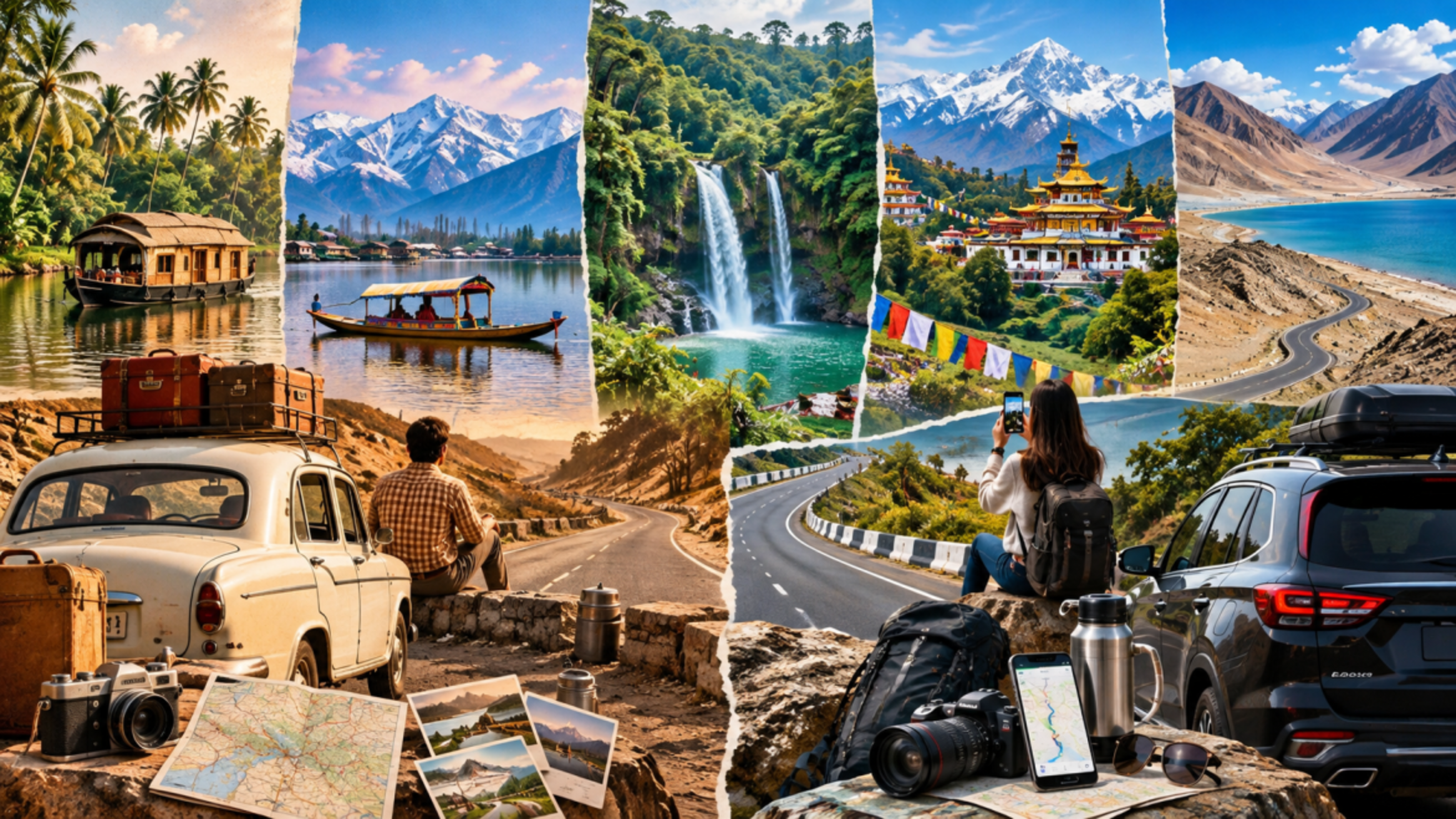
Before Instagram, There Were Road Trips: How India Travelled Then & Now
There was a time when planning a trip meant asking a friend who had already been there, drawing a rough route on paper and hoping the car would make it through the journey without any trouble.
There were no Google Maps telling you which road to take. No Instagram reels showing you the exact viewpoint before you arrived. No travel apps comparing hundreds of hotels in a few seconds.
You simply packed your bags and went.
For many travellers in the 1980s, a holiday was less about getting the perfect photograph and more about the journey itself. A long drive with family or friends, a cassette playing in the background, roadside tea breaks and the excitement of reaching a place you had mostly heard about from someone else.
Travel was slower.
Information was limited.
And in many ways, that made discovering a destination feel more personal.
Today, travelling across India is a completely different experience. We can book flights and hotels from our phones, check weather updates before leaving, find restaurants through reviews and plan an entire itinerary before the trip even begins.
We photograph everything.
We share everything.
And sometimes, we even know what a place will look like before we’ve actually seen it.
But here’s the interesting part – the destinations themselves haven’t lost their magic.
Kerala still has its backwaters and greenery. Kashmir still has its mountains and winter landscapes. Meghalaya still has its waterfalls and misty roads. Sikkim still feels like a Himalayan escape, while Ladakh continues to attract travellers looking for adventure.
What has changed is the way we reach them, experience them and remember them.
So, let’s take a little trip back in time and see how some of India’s favourite destinations have changed from the 1980s to 2026.
Travel Then vs Travel Now: What Really Changed?
The difference between travelling in the 1980s and travelling today isn’t simply about old cars versus modern vehicles.
It is about the entire travel experience.
Back then, travellers often had to depend on word of mouth. Someone’s cousin had visited Kashmir. A colleague had taken a road trip through Kerala. A neighbour knew about a beautiful place in the hills.
There were fewer ways to research a destination, so discovering something unexpected was almost guaranteed.
Today, information is everywhere.
You can search for the best hotels, read reviews, watch destination videos, check road routes and build a detailed itinerary before leaving home.
That has made travel much easier.
But it has also changed the feeling of discovery.
Earlier, you might arrive somewhere without knowing exactly what to expect.
Today, you may already have saved “10 best places to visit” posts before your flight even takes off.
Neither way is necessarily better.
They are simply different.
And when you compare the two, one thing becomes surprisingly clear: the love for travel has stayed the same.
🌴 Kerala: From Old-School Road Trips to Easy Escapes
Kerala is a perfect place to begin because the state has always had something that travellers look for when they want to slow down.
Green landscapes.
Palm-lined roads.
Backwaters.
Beaches.
Hill stations.
And that feeling that you don’t necessarily have to rush anywhere.
Kerala in the 1980s: The Journey Was Part of the Holiday
In the 1980s, reaching Kerala could be an adventure in itself.
For many travellers, road journeys meant long hours in cars, basic maps and plenty of stops along the way. There were fewer accommodation choices, fewer tourist facilities and much less information available before the trip.
You might have known that you wanted to visit a beautiful hill station or spend time near the backwaters, but the finer details were often discovered once you reached there.
And that was part of the fun.
A family could set out on a long drive with bags packed in the car, stopping along the way for food or tea.
There was no pressure to photograph every stop.
No one was checking whether the location was “Instagram-worthy.”
You simply enjoyed the road, the conversations and the anticipation of reaching somewhere new.
Kerala’s quieter side also felt easier to find because tourism was not as digitally visible as it is today.
Kerala Today: Easier to Reach, Easier to Explore
Fast-forward to 2026 and planning a Kerala trip is much easier.
Travellers have access to better information, more accommodation options and more convenient ways to organise transportation.
You can choose between budget stays, boutique properties, resorts, homestays and unique experiences depending on your travel style.
The experience has also become more diverse.
A Kerala holiday can mean relaxing on a houseboat in the backwaters, exploring tea plantations around Munnar, enjoying local food, discovering heritage areas in Kochi or spending time along the coast.
And then there is photography.
A destination that once lived mostly through memories and printed photographs can now be captured from almost every angle.
But despite all these changes, Kerala’s basic charm hasn’t disappeared.
The roads may be better.
The hotels may be more varied.
The planning may be easier.
But the feeling of looking out at a green landscape while travelling through Kerala?
That hasn’t changed much.
🏔️ Kashmir: Same Beauty, Different Journey
If there is one destination that proves landscapes don’t need to change to remain unforgettable, it is Kashmir.
The mountains, valleys, lakes and winter scenery have attracted travellers for generations.
But the way people experience Kashmir today is very different from the way they did decades ago.
Kashmir Then: A Different Kind of Adventure
Travelling to Kashmir in the 1980s required considerably more planning and patience.
Road journeys could take time, vehicles were simpler and information about places was much harder to access.
Travellers often depended on local knowledge and recommendations to decide where to go and what to see.
There was no quick search for “best places to visit in Kashmir” before leaving home.
You went with what you knew.
And perhaps that’s why the experience could feel more spontaneous.
Winter trips, in particular, required preparation and a willingness to deal with cold weather and road conditions without the convenience of today’s travel information.
The journey itself was a bigger part of the adventure.
Kashmir Now: Comfort Meets Adventure
Today, Kashmir is much easier to research and plan.
Travellers can compare stays, organise transportation, check weather updates and build detailed itineraries before arriving.
Winter travel has also become an experience in itself for people looking for snow, photography and mountain adventures.
Modern travel doesn’t necessarily make Kashmir less adventurous.
It simply changes the kind of adventure.
Instead of worrying about how you’ll find basic information about your destination, you can spend more time thinking about what you actually want to experience.
A snow-covered landscape.
A peaceful morning near a lake.
A drive through the mountains.
Or simply a few days away from city life.
And that’s the beautiful part of comparing Kashmir then and now.
The photographs may look different.
The vehicles may be different.
The clothes, cameras and travel styles may have changed.
But the mountains are still doing most of the work.
🌧️ Meghalaya: When the Journey Was the Destination
Meghalaya has always been the kind of place where the road deserves almost as much attention as the destination.
Think winding roads, green hills, mist hanging over the trees and waterfalls appearing when you least expect them.
Today, travellers know Meghalaya for places like Shillong, Cherrapunji, Dawki and Mawlynnong. You can search for a route, save a list of cafés, check reviews and plan exactly where you want to stop.
But the Meghalaya of the 1980s offered a very different kind of travel experience.
Meghalaya Then: Fewer Plans, More Discovery
Travelling through Meghalaya decades ago was much less predictable.
There were fewer tourists, fewer travel resources and much less information available before starting the journey. Roads were quieter, and travellers often depended on local recommendations or simply explored whatever caught their attention along the way.
A road trip through the hills could mean stopping because the scenery looked beautiful rather than because a particular place had gone viral online.
There was no pressure to reach a famous viewpoint before sunset just because you had seen it in a photograph.
You could simply enjoy the road.
And that is perhaps what made Meghalaya feel so special.
The journey wasn’t something you had to get through before reaching the destination.
The journey was the destination.
Meghalaya Now: Road Trips, Waterfalls & Experiences
Today, Meghalaya has become a favourite among travellers who want a mix of nature, road trips and adventure.
The way people discover the state has changed completely.
A traveller can now plan a route before arriving, find stays online, discover local cafés through social media and save waterfalls and viewpoints on a digital map.
And, of course, there is photography.
Meghalaya almost seems made for it.
The green landscapes, dramatic clouds, waterfalls and winding roads have made the state particularly popular among young travellers and road-trip groups.
But despite the increase in tourism and easier planning, Meghalaya still offers something that hasn’t changed much.
There are moments when you put the phone down, look out of the car window and realise that no photograph quite captures what you’re seeing.
That feeling?
Still very much alive.
🏞️ Sikkim: From Remote Himalayan Escape to Traveller Favourite
Sikkim is another destination where the difference between travelling then and now becomes easy to notice.
Today, Sikkim is firmly on the radar of travellers looking for mountains, monasteries, lakes, scenic drives and Himalayan experiences.
But getting there and exploring it was not always as straightforward as it is today.
Sikkim Then: A Journey That Needed Patience
In the 1980s, travelling through Sikkim meant dealing with a much simpler travel infrastructure.
Access to many areas was more difficult, travel information was limited and travellers had fewer accommodation and transportation choices.
There was no easy way to search for the best viewpoints or create a detailed route before leaving.
You had to depend much more on local knowledge.
And when you finally reached the mountains, the experience could feel wonderfully remote.
There were fewer distractions competing for your attention.
No constant notifications.
No travel reels telling you what to expect.
No pressure to recreate somebody else’s photograph.
Just the mountains, the road and the people travelling with you.
Sikkim Now: Easier Travel, More Ways to Explore
Today, planning a Sikkim trip is far more convenient.
Travellers can research destinations beforehand, compare accommodation options and organise transportation before reaching the state.
The tourism experience has also expanded.
People visit Sikkim for mountain views, monasteries, lakes, road trips, trekking and adventure experiences. Popular destinations can now be easily discovered through travel platforms and social media.
For younger travellers especially, Sikkim has become a place where a mountain escape and a memorable road trip can exist together.
You can plan your route, take photographs, share the experience instantly and still find quiet moments away from the crowds.
That’s the interesting thing about modern travel.
Technology has made it easier to find places.
But once you reach Sikkim, the mountains still give you plenty of reasons to stop looking at your screen.
What Changed Across These Destinations?
Look at Kerala, Kashmir, Meghalaya and Sikkim together and one pattern becomes clear.
The biggest change isn’t necessarily the destinations.
It’s access.
Travelling has become easier to plan.
Information is easier to find.
Accommodation is easier to book.
Transportation is more organised in many places.
And travellers have more choices than ever before.
But there is another change too.
The way we remember travel has changed.
Earlier, you might have returned home with a few photographs and a handful of stories.
Today, a trip can produce hundreds of photographs, videos, reels, location tags and travel posts.
We can share a sunset with people thousands of kilometres away within seconds.
That’s incredible.
But sometimes, it also means we’re busy documenting the moment instead of actually experiencing it.
And maybe that’s the one thing worth borrowing from the old way of travelling.
Not the unreliable maps.
Not the long journeys.
Not the limited hotel choices. 😂
Just the ability to occasionally put the camera away and simply look around.
The Roads May Have Changed, But the Reason We Travel Hasn’t
A family driving through Kerala decades ago and a group of friends driving through Meghalaya today may look completely different.
The cars are different.
The clothes are different.
The cameras are different.
The roads may be different.
But the excitement of seeing a new place?
That’s surprisingly familiar.
Someone is still sitting in the passenger seat pointing out a beautiful view.
Someone is still asking, “How much longer?”
Someone is still stopping for tea.
And someone is still saying:
“Let’s stay one more day.”
That’s probably the part of travel that technology can’t replace.

